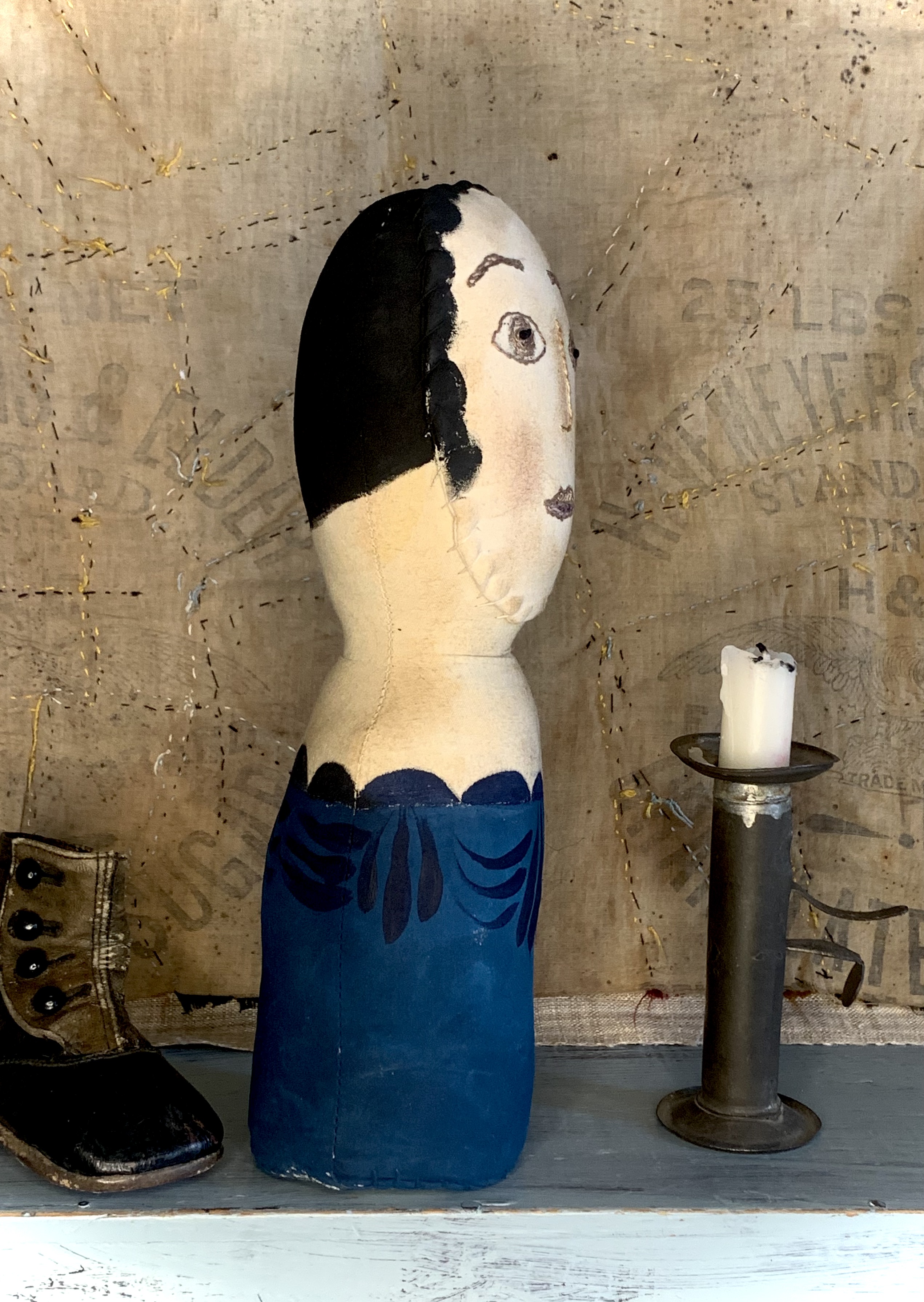


Hilda is a reproduction of a classic cloth doll from the early 1800s, based on a photograph I found years ago in a book of old dolls. I decided to create a similar cloth doll and call my version of her Hilda Dibble.
Hilda is 14 inches tall and wears pantalets, a petticoat, dress, as well as a cape and bonnet. I’ve provided patterns for her body, arms, legs, and her bonnet. Her pantalets, petticoat, and dress are easy to sew, with instructions instead of patterns. There also are instructions for painting Hilda’s face and creating her hair.


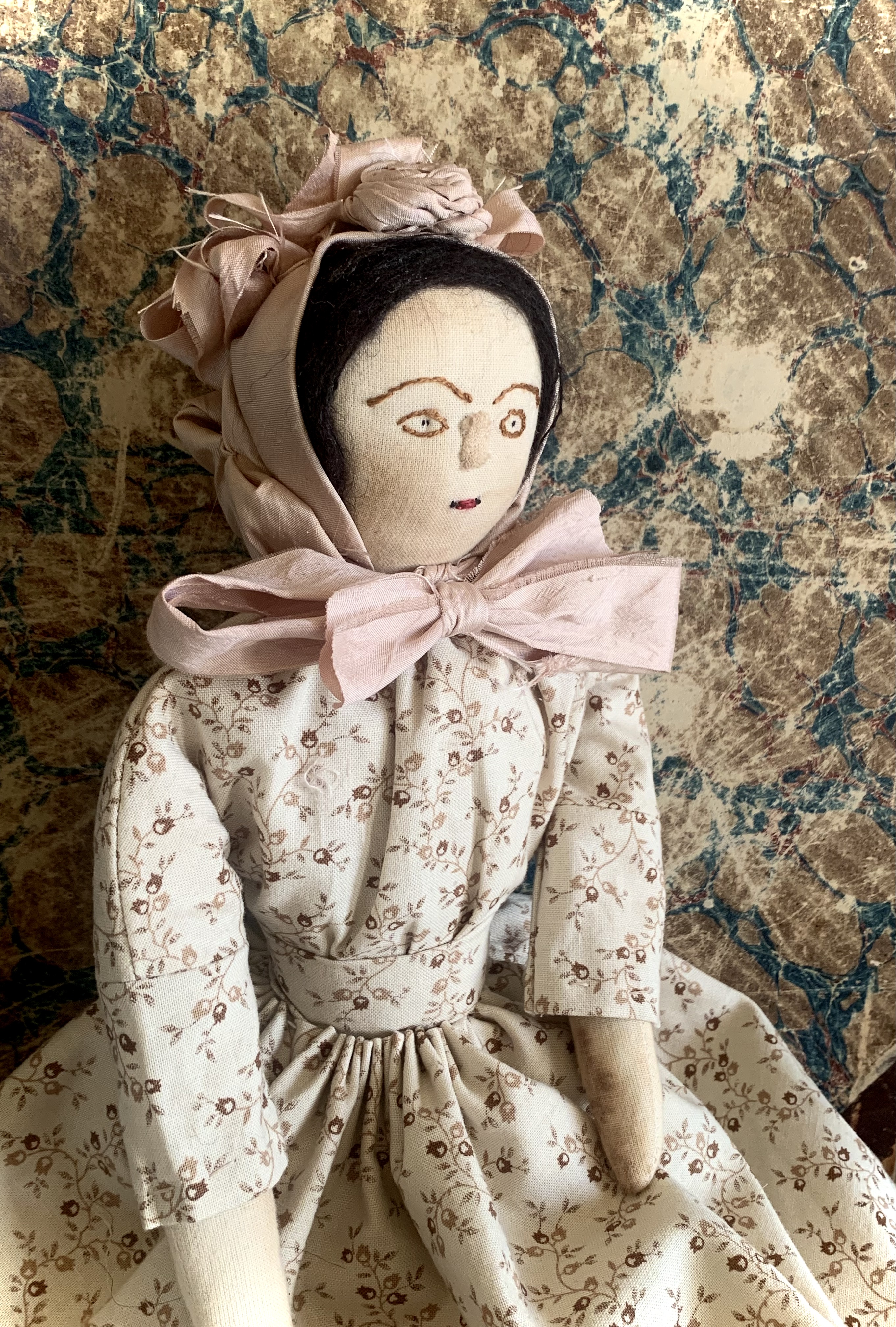
Verity is a reproduction of a classic cloth doll from the early 1800s. I found a photograph of the actual doll in a book of old dolls, explaining that this doll originated in Philadelphia. I decided to call my version of her Verity. While she can be considered a primitive doll, the original Verity had a silk scarf as her head covering, making her seem somewhat fancy.
Verity is 14 inches tall and wears pantalets, a petticoat, skirt with waistband, a top, and has painted-on shoes, in addition to her scarf and a rosette. Her two-piece legs enable her to sit nicely. I’ve provided patterns for her body, arms, legs, and her top. Her pantalets, petticoat, and skirt are easy to sew, with instructions instead of patterns. There also are detailed instructions for embroidering her face.


About Letty Bea
Letty is in keeping with handmade dolls popular throughout America’s 300-year history. These dolls were created using whatever fabrics and stuffing were at hand, sometimes created by a mother as a gift for her child, sometimes by a child just learning to sew.
Above all, dolls like Letty Bea always have been a reflection of the very best that could be done with varying skills and scarce supplies.
When finished, Letty Bea is 14 inches tall and has a sweet, embroidered face. She wears a simple top, skirt, and apron, along with her bonnet.


About the Pioneer Button Doll
Ingenuity was important for a successful journey when a pioneer family traveled west in the 1800s on the Oregon Trail. And this little doll combined two practical purposes necessary in the cramped quarters of a covered wagon.
For one, the doll was a sweet plaything for children confined in the wagon for months at a time. And secondly, making the doll’s legs from stacks of buttons was a clever way to keep track of buttons needed to create or mend the family’s clothing on the long trip.
This Pioneer Button Doll is around 8 inches tall, depending on how many buttons you use in creating her legs. She’s a very simple doll with a stuffed body, primitive face and hair, and clothed in plain pantaloons and dress. She is based on an actual button doll displayed in an Oregon museum along the path of the historic Oregon Trail.


About the Eliza Doll & Pincushion
Here are two projects designed to delight girls in the early 1800s who were just learning to sew. One is a small doll and the other is a pincushion in the shape of a heart. Both were created by Eliza Leslie (1787-1858), who was born in Philadelphia and whose only formal education was cooking and sewing classes. Still, she became one of the century’s most popular authors on domestic topics.
Eliza often wrote under the name “Miss Leslie.” She was best known for her 1837 “Directions for Cookery in its Various Branches,” which was the most popular cookbook of the 1800s. Both the little doll and the heart pincushion were included as projects in Miss Leslie’s popular “American Girl’s Book” published in 1831.
She called the doll “A Common Linen Doll.” Hers was made of rolled fabric, wore a simple dress, and was shown without a face, which could easily be created by the young seamstress. The doll’s height depends on how much fabric is rolled up, as you’ll see in these directions.
The pincushion’s size also depends on how much fabric is available. It hangs from a ribbon and is a charming sewing tool.


In the world’s long history of dolls, among the most popular have been the “peg woodens” originating in Europe as far back as the 1600s and becoming the favorites of children on both sides of the Atlantic in the 1800s. These dolls were carved from wood and had pegged joints in their arms, legs, hips, and shoulders. They most often were sold without clothes so their new owners could create their wardrobe from whatever materials were at hand.
I carved my own peg wooden many years ago because I adore this style of doll. And as also a lover of cloth dolls, I decided to design a sweet little cloth doll with features resembling a peg wooden.
And that’s how Prudence Jane Plum came into being.